
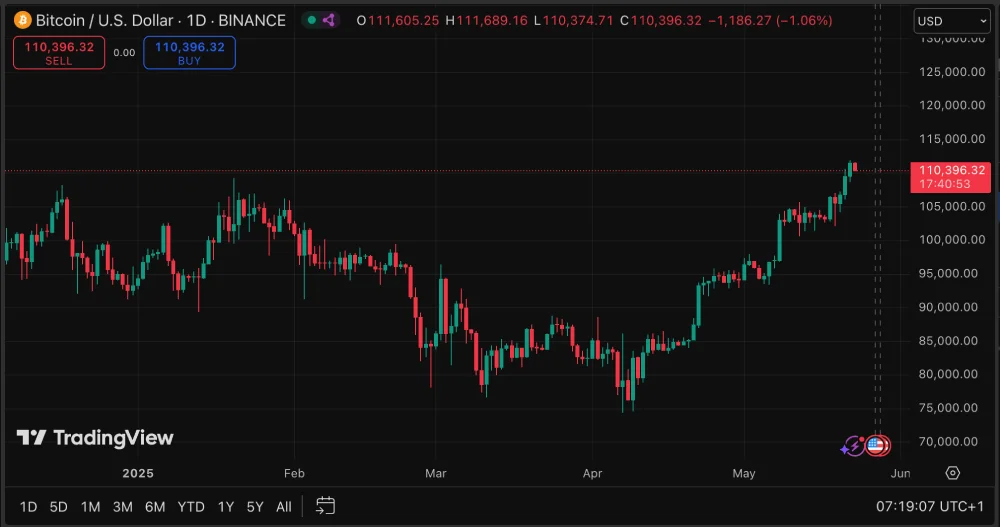
In May 2025, Bitcoin surged past $110,000, surpassing its previous all-time high of $109,026 (January 20, 2025), signaling robust bullish momentum. Institutional capital inflows, global monetary easing expectations, Bitcoin’s halving-induced supply constraints, the Trump administration’s pro-crypto policy outlook, and positive developments in U.S.-U.K. trade negotiations have driven this breakthrough. The U.S.’s recent tariff policy adjustments on China (reduced from 145% to 30%, including a 10% base tariff and 20% fentanyl-related tariffs) triggered short-term market volatility, but Bitcoin rebounded, reinforcing its status as a safe-haven asset. The altcoin market is showing significant activity, with signs of capital rotation, and market participants anticipate an imminent altcoin season. This article analyzes the reasons behind Bitcoin’s new high, examines the impact of U.S.-China tariff policies and U.S.-U.K. trade negotiations on Bitcoin and altcoins, and evaluates the prospects for altcoins to soar.
Reasons for Bitcoin’s Price Breaking New High
Institutional Capital Inflows and ETF Surge
Institutional investment remains the primary driver of Bitcoin’s breakthrough. Since their approval in early 2024, U.S. spot Bitcoin ETFs have attracted substantial inflows. On May 7, 2025, Bitcoin ETFs recorded a net inflow of $1.42 billion, with BlackRock’s IBIT ETF managing over $150 billion in assets and maintaining positive inflows for 20 consecutive trading days, totaling over $5 billion. MicroStrategy’s acquisition of 1,070 BTC further reduced circulating supply, reinforcing Bitcoin’s scarcity narrative.
The Trump administration’s nomination of Paul Atkins, a crypto-friendly candidate, as SEC chair has reduced regulatory uncertainty, attracting more institutional capital. Discussions on the X platform highlight investor confidence in the institutional-led “digital gold” narrative, propelling Bitcoin past $109,026 to above $110,000.
Macroeconomic Environment and Monetary Easing
A favorable global liquidity environment has supported Bitcoin’s surge. China’s central bank cut benchmark lending rates to counter U.S. tariff pressures, while bond market yields hit multi-year lows. In the U.S., the Federal Reserve anticipates a 70% chance of a 25-basis-point rate cut in June 2025 due to inflationary pressures and potential economic slowdown from tariffs. Historical data shows that increases in global M2 money supply correlate with Bitcoin price rallies.
The Trump administration’s pro-crypto policy expectations, including a proposed Bitcoin strategic reserve and support for dollar-pegged stablecoins, have boosted market sentiment, enhancing Bitcoin’s appeal as a safe-haven asset and driving its new high.
Bitcoin Halving and Supply-Demand Imbalance
The fourth Bitcoin halving in April 2024 reduced block rewards to 3.125 BTC, tightening supply. Currently, about 95% of Bitcoin’s 21 million total supply is in circulation, with only 1.03 million BTC left to be mined. This supply-demand imbalance, amplified by growing institutional and retail demand, has driven the price. The current price above $110,000 reflects strong market recognition of Bitcoin’s scarcity, fueling its breakthrough.
Technical Indicators Remain Bullish
Technical analysis indicates Bitcoin is in a strong bullish trend. The 50-day simple moving average (SMA) stands at $92,255, and the 200-day SMA at $86,257, both trending upward, confirming a bullish mid- and long-term outlook. The Relative Strength Index (RSI) is approximately 68-70, below the overbought threshold (>70), suggesting room for further gains. Bitcoin’s break above the 100-day and 200-day exponential moving averages (EMAs) and formation of a “cup-and-handle” pattern facilitated its breakthrough above $109,026, with the next resistance zone at $115,000-$120,000.
U.S.-China Tariff Policy and U.S.-U.K. Trade Negotiations
U.S.-China Tariff Policy
Since February 2025, the U.S. imposed 25% tariffs on Canada and Mexico. Tariffs on China, previously as high as 145% in April, were reduced to 30% (including a 10% base tariff, 20% fentanyl-related tariffs, and other existing tariffs like Section 301 and Section 232) following a May 12 agreement, with a 90-day suspension until August 12. China lowered tariffs on the U.S. from 125% to 10% and paused some non-tariff retaliatory measures. These tariff policies have impacted Bitcoin as follows:
Short-Term Volatility: Tariff-induced economic uncertainty led to short-term declines in risk assets. On April 3, 2025, Bitcoin fell 5.4% to $74,500. X platform discussions noted that tariffs tightened global liquidity, causing an 8% Bitcoin pullback. The April “Liberation Day” tariff announcement reduced the crypto market’s total capitalization by 8% to $3.2 trillion.
Long-Term Benefit: Tariffs may weaken the U.S. dollar’s hegemony, enhancing Bitcoin’s appeal as an alternative reserve asset. VanEck’s Head of Digital Assets Research, Mathew Sigel, suggests that a weaker dollar could elevate Bitcoin and gold in global reserve systems. The Trump administration’s Bitcoin strategic reserve proposal positions it as a gold-like asset, attracting sovereign investments. X platform discussions indicate that the May 12 tariff reduction to 30% and 90-day suspension alleviated market pressure, boosting risk appetite and driving Bitcoin above $110,000.
U.S.-U.K. Trade Negotiations
Progress in U.S.-U.K. trade negotiations has injected optimism into the crypto market. On May 18, 2025, U.K. Prime Minister Keir Starmer and the Trump administration reached an agreement to reduce tariffs on British luxury cars (e.g., Jaguar, Land Rover) and steel, saving the U.K. economy approximately £6.5 billion ($8.6 billion) in tariff costs. U.S. Treasury Secretary Scott Bessent stated that tariffs would revert to “reciprocal” levels (April 2 levels) if no further agreement is reached within the 90-day suspension period. The deal requires U.K. firms to comply with U.S. security regulations, including monitoring supply chain transparency and foreign ownership structures, prompting criticism from China for potentially excluding Chinese products from U.K. supply chains.
Short-Term Impact on Crypto Markets: The U.S.-U.K. trade agreement has eased global trade tensions, boosting market risk appetite and supporting Bitcoin’s surge past $110,000. X platform discussions suggest that reduced tariffs on U.K. goods could stimulate blockchain projects related to consumer goods (e.g., supply chain finance and NFTs), providing short-term support for altcoins.
Long-Term Impact on Crypto Markets: The agreement’s emphasis on supply chain transparency may accelerate blockchain adoption in trade compliance, benefiting altcoin projects like VeChain and Waltonchain. However, restrictions on Chinese involvement in U.K. supply chains could reduce trading volumes for Asia-related crypto assets.
Prospects for Altcoins to Soar
Current Market Dynamics
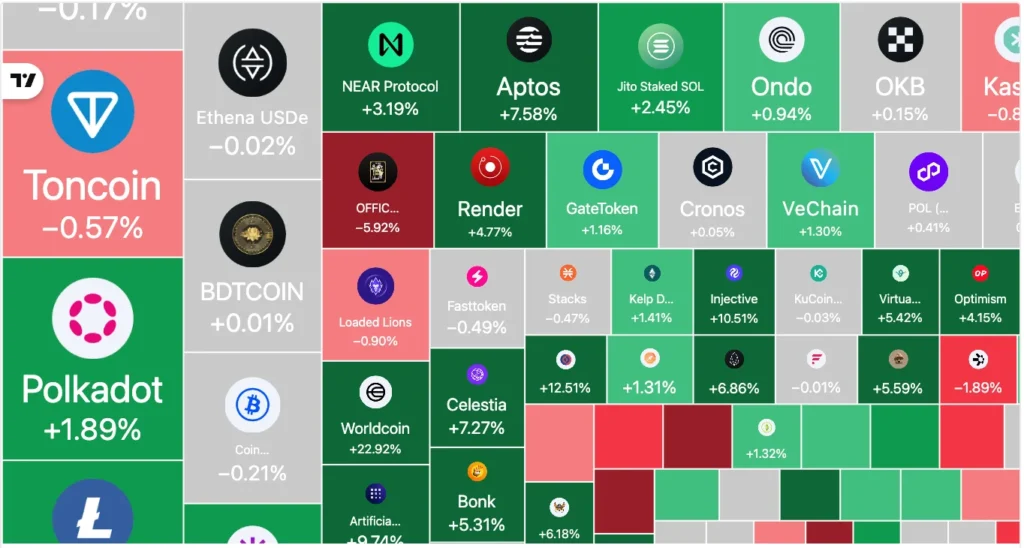
With Bitcoin above $110,000, its market dominance is around 63-65%, recently dipping to 63.89%, signaling capital rotation to altcoins. Ethereum (ETH, ~$4,000), Solana (SOL, ~$200), XRP, and Dogecoin (DOGE) have posted gains of 13%, 7.6%, 9.7%, and 56% this month, respectively. CoinMarketCap’s Altcoin Season Index has risen from 23 to 36, nearing the “neutral” zone, indicating heightened market activity and signaling an impending altcoin season.
X platform discussions highlight that declining Bitcoin dominance and surging Meme coins (e.g., DOGE) foreshadow an altcoin season. HTX Research notes that Bitcoin’s options implied volatility (IV) remains stable at 50%-55%, well below the 80% typical of bull market peaks, suggesting the market is not overheated and altcoins have significant upside potential.
Impact of Tariff Policy and Trade Negotiations on Altcoins
U.S.-China tariff policies and U.S.-U.K. trade negotiations have a complex impact on altcoins due to their higher correlation with tech stocks and greater volatility:
Short-Term Pressure: U.S.-China tariffs’ inflationary and economic uncertainty effects increase selling pressure on altcoins. Following the April tariff announcement, Ethereum dropped to $2,143, with $2.23 billion in market liquidations within 24 hours. X platform discussions suggest that altcoins underperformed Bitcoin in the short term due to high liquidity sensitivity and diminished appeal from Binance’s listing strategies.
Long-Term Opportunity: U.S.-China tariffs boost demand for stablecoins (e.g., USDT, USDC) to hedge currency fluctuations in cross-border transactions. The Trump administration’s support for dollar-pegged stablecoins could invigorate altcoin ecosystems (e.g., DeFi and Layer-2 projects). The U.S.-U.K. trade agreement’s supply chain transparency requirements may promote blockchain adoption in trade compliance, benefiting altcoins like VeChain. X platform discussions indicate that the 90-day tariff suspension and U.S.-U.K. trade deal provide a window for altcoins to recover, with capital likely to rotate rapidly to altcoins following Bitcoin’s $110,000 breakthrough.
Altcoin Season Triggers
Altcoin seasons typically emerge after Bitcoin breaks new highs and enters consolidation. Current signs of capital rotation are evident, with the ETH/BTC ratio rebounding from its 2020 low and stablecoin inflows rising 5%. Bitcoin’s consolidation around $115,000 post-breakout will create ideal conditions for altcoins to soar. Historical data from 2017 and 2020-2021 shows altcoin seasons coincide with Bitcoin consolidation and a weakening dollar, with an expected altcoin season in June or July 2025, lasting 1-2 months, potentially driving 20-50% gains for ETH, SOL, XRP, and others.
Risks and Optimal Entry Timing
Altcoin performance is highly dependent on Bitcoin’s price movements, and investors should remain cautious of short-term pullback risks, monitoring key support levels (e.g., $100,000 or $95,000). Uncertainties in tariff policies (e.g., potential reinstatement of higher tariffs after the 90-day suspension) and ongoing U.S.-U.K. trade negotiations may amplify market volatility, necessitating close monitoring of U.S.-China and U.S.-U.K. trade developments.
The optimal entry window for altcoins is 1-2 weeks after Bitcoin consolidates around $115,000, when altcoins are likely to soar. Investors should monitor RSI (avoiding overbought levels >70) and MACD crossover signals for precise entry points.
Conclusion
Bitcoin’s price above $110,000, surpassing its previous high of $109,026, is driven by institutional inflows, monetary easing expectations, halving-induced supply constraints, bullish technical indicators, and progress in U.S.-U.K. trade negotiations. The May 12 U.S.-China agreement to reduce tariffs on China from 145% to 30% (including a 10% base tariff and 20% fentanyl-related tariffs) caused short-term volatility (April’s drop to $74,500), but long-term, it may weaken dollar hegemony, enhancing Bitcoin’s appeal as an alternative reserve asset. The U.S.-U.K. trade deal, reducing tariffs on U.K. goods and emphasizing supply chain transparency, boosts short-term market risk appetite and supports long-term blockchain adoption. The next resistance zone is $115,000-$120,000. The altcoin market is vibrant, with clear capital rotation signals, and Bitcoin’s consolidation will trigger an altcoin season, likely in June or July, with ETH, SOL, XRP, and others poised for 20-50% gains. Investors should monitor U.S.-China and U.S.-U.K. trade developments and technical indicators while managing risks carefully.
Investment Recommendations
Bitcoin: Hold positions post-breakout, targeting the $115,000-$120,000 resistance zone, while staying alert for tariff- and trade-related pullbacks.
Altcoins: During Bitcoin’s consolidation, diversify into fundamentally strong altcoins (e.g., ETH, SOL, XRP, VeChain). Monitor ETH/BTC ratios and RSI/MACD signals for optimal entry.
Risk Management: Given high crypto market volatility, set stop-loss orders and closely track U.S.-China tariff negotiations (90-day suspension until August 12) and U.S.-U.K. trade developments to assess liquidity risks.
Disclaimer: This article is for informational purposes only and does not constitute investment advice. The cryptocurrency market carries high risks, and investors should conduct their own research and exercise caution.